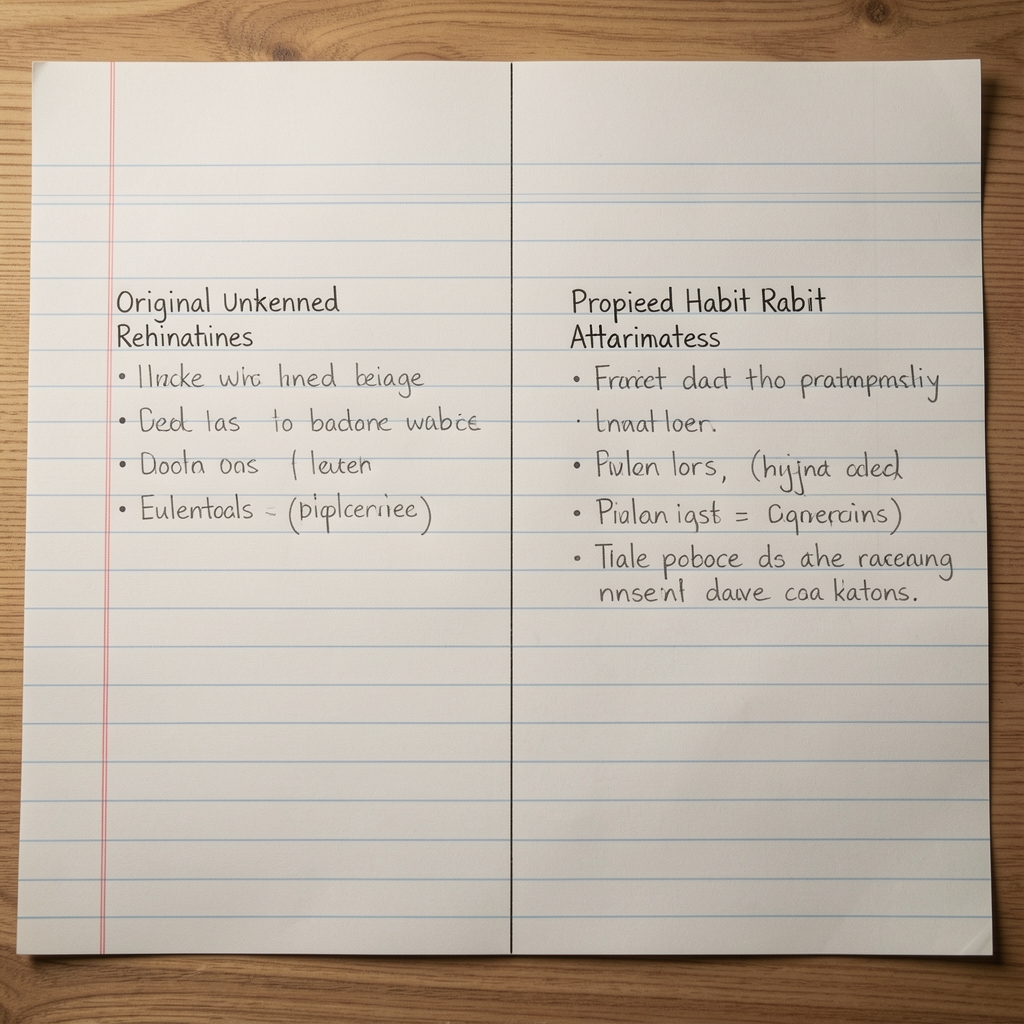
The Belda methodology structures behaviour change as an observable, documentable process. Four sequential phases move from cue identification through to long-term behaviour shift — each producing a verifiable record of progress and pattern modification.
Methodology Schematic · BLD-MTH-001

Every behavioural pattern — wanted or unwanted — begins with an identifiable trigger. The first phase of the Belda methodology is a structured observation period lasting 7–14 days in which the practitioner records, for each instance of the target behaviour, the preceding context: time of day, location, emotional state, preceding activity, and social setting.
The resulting cue map is a written inventory of trigger contexts. Patterns typically emerge within the first ten entries. The cue map becomes the reference document for Phase Two — without it, substitution efforts address the routine in isolation from its trigger, which the Belda archive records as the primary cause of early-stage pattern reversion.
With the cue map established, Phase Two identifies a substitute routine that responds to the same trigger and satisfies a comparable reward signal. The selection criterion is structural compatibility: the replacement must fit the temporal and contextual constraints of the original routine while redirecting its functional output.
Dopamine and habits are addressed directly here: because the anticipatory signal is generated by the cue rather than the action, the substitute must offer a reward with sufficient salience to maintain the loop. Belda records show that reward-signal mismatch — selecting a substitute that is contextually available but functionally unrewarding — is the primary cause of Phase Two abandonment.
Phase Three addresses the physical context in which the behaviour occurs. Environmental design operates on the principle that the path of least resistance determines the most likely action. Redesigning the environment to reduce the accessibility of the unwanted cue and increase the visibility of the substitute routine shifts the default outcome without requiring ongoing conscious effort.
Documented modifications are introduced one at a time, each accompanied by a seven-day observation log. The cumulative effect of multiple small environmental changes is recorded as significantly more durable than any single large structural alteration. This is a direct expression of the small steps approach applied at the level of physical space.
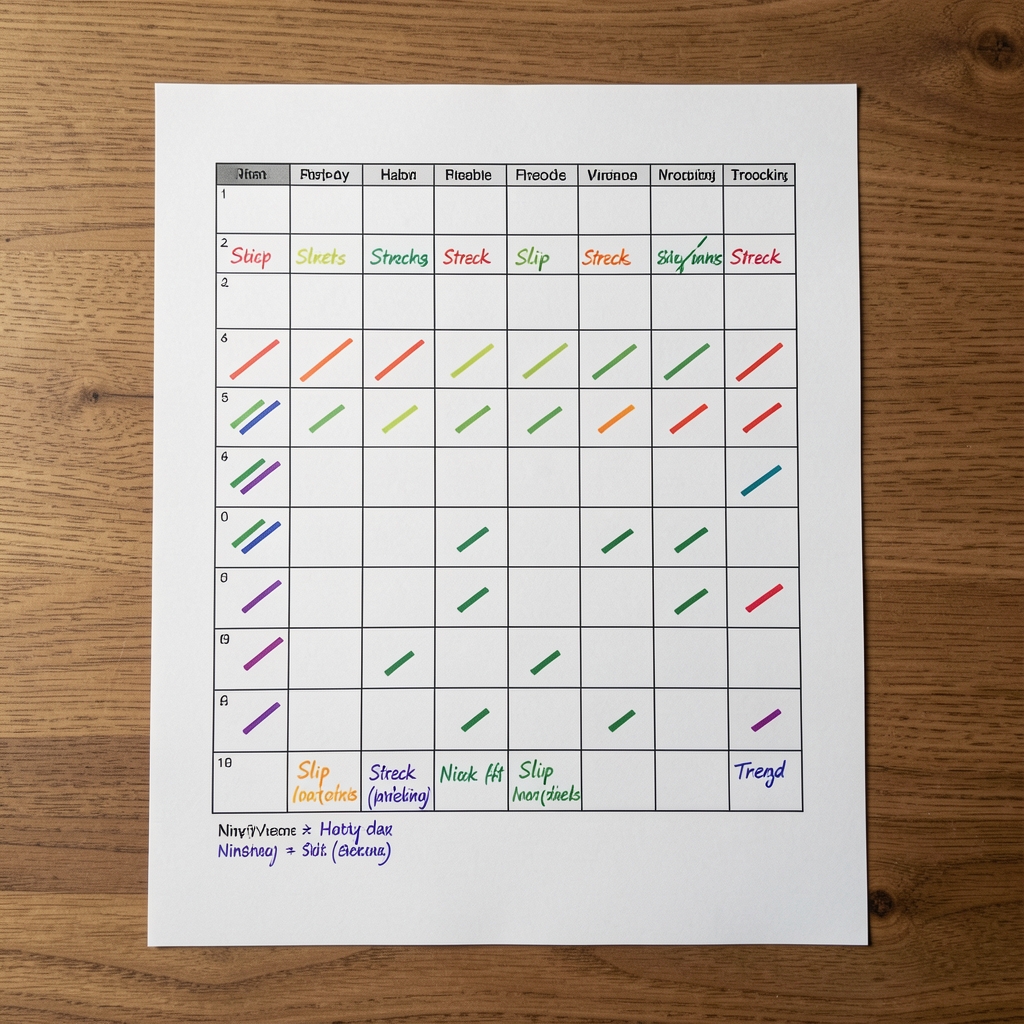
The final phase establishes a longitudinal record of the new routine across a minimum 90-day observation window. Consistency over perfection is the operating principle: the tracking record does not penalise individual slip instances but documents their context, identifying the cue or environmental condition that produced the deviation.
Long-term behaviour shift is confirmed when the new routine operates automatically in the presence of its cue without requiring deliberate initiation. Belda records show this threshold is typically reached between day 45 and day 90, with significant individual variation. The Phase Four archive continues beyond this threshold, documenting the stability of the new pattern under changing environmental conditions over six and twelve months.
Every Belda observation record follows a consistent documentation protocol: date, time, context, entry type (cue map, substitution trial, environmental modification, or consistency log), and revision number. This protocol ensures that longitudinal records can be reviewed for pattern recognition across extended time periods without ambiguity.
The revision numbering system — format DD-N, where DD is the phase designation and N is the sequential revision within that phase — allows tracking of changes to substitution selections, environmental modifications, and tracking methodologies as the programme evolves. This mirrors the documentation conventions of the quality-management field: each record reflects both the current state and the path of revisions leading to it.
Field notes within each phase are supplemented by periodic review entries at the 7-day, 30-day, and 90-day marks. These review entries apply a structured reflection prompt drawn from the Belda journaling for change framework, producing a layered record of both quantitative (completion rate, streak length) and qualitative (perceived ease, contextual obstacles) data.
Each archive entry carries: date stamp, phase reference, entry type code (CM/ST/EM/CT), context notation, and revision suffix. Format adopted from Belda documentation protocol, Revision 01-A.
Where published research informs a programme design decision, the source reference is recorded in the phase notes alongside the specific finding applied. This maintains a clear chain of documented reasoning for each methodological choice.
Methodology revisions are introduced only after a minimum 30-day observation period has confirmed the current version's performance record. Change proposals are logged with a justification entry before any modification to the standard protocol is applied.
All completed phase records are retained in the Belda archive with full revision history. No entry is deleted or overwritten; modifications are logged as new revisions against the original record. The archive currently holds 18 completed methodology cycles.
The Belda methodology draws on published findings in behavioural science and habit formation research. Where specific studies inform a design decision, they are referenced in the relevant phase documentation. No claim extends beyond what the cited source directly records.
Alongside published research, the Belda archive holds a body of original field observation records accumulated across 18 completed programme cycles. Observations are documented contemporaneously and reviewed against the published-research basis at each 90-day assessment point.
The methodology has been through four major revision cycles since its first documented version in 2019. Each revision is logged with the specific observation or published finding that prompted the change. The current version (04-C) reflects accumulated learning from all preceding cycles.
Selected questions from the Belda archive and methodology review sessions.
Substitution applied without cue mapping addresses the routine while leaving the trigger context unchanged. The archive records show that this approach produces an initial reduction in the unwanted behaviour followed by reversion within two to six weeks as the cue reactivates the path of least resistance. Phase One exists to make the trigger structure visible and explicit before any intervention in the routine is attempted.
Automaticity is recorded in the Phase Four log when the practitioner notes, for three consecutive weeks, that the substitute routine initiates without deliberate decision-making — it occurs in the presence of the cue without a preceding conscious choice entry in the daily notation. This is a self-reported threshold, recorded contemporaneously in the tracking log rather than assessed retrospectively.
The Belda methodology does not require cue removal. Phase Three environmental design targets the response to the cue rather than its elimination — making the substitute routine more accessible than the unwanted one at the moment the cue fires. Where a cue is unavoidable (a social context, a fixed daily event), the programme focuses exclusively on Phase Two substitution design and Phase Four tracking, without any expectation of environmental modification.
A slip is logged as a context entry — the date, the cue context, and any deviation from the standard environmental conditions are recorded without evaluative language. The next-day entry proceeds normally. The consistency over perfection principle is operationalised here: a single missed entry does not reset the streak counter; it adds a context note. The 30-day review then examines whether slip entries share a common contextual pattern requiring a Phase Two or Phase Three adjustment.
The Belda methodology is a documentation and observation framework for personal behaviour change. It is a structured journaling and tracking system, not a regulated advisory programme of any kind.
We recommend speaking with a qualified wellness or nutrition professional before introducing any structured programme to your daily routine, particularly if you have specific dietary requirements.